Back to Blog
General5 min read
Why Growth Breaks Startups (And It's Rarely the Growth Itself)
Growth doesn't break startups — weak structure does. Learn the 5-pillar operational audit founders used live at Launchpad, Isle of Man.
20 July 2026
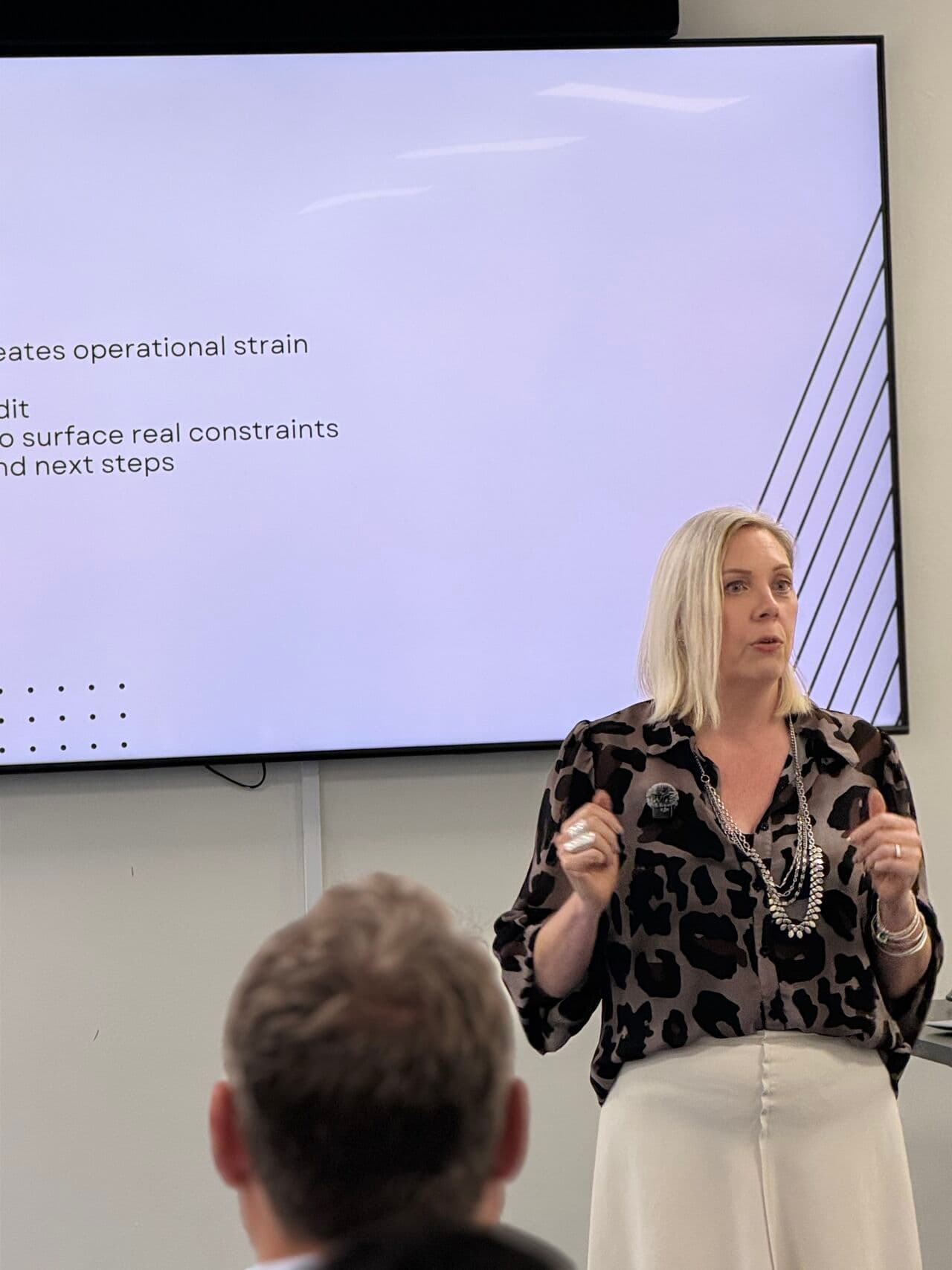
Every founder wants more customers, more revenue, more team members. But at Launchpad's most recent founder session, operations specialist Lisa Karran of The Knowledge Broker Limited made a case that should reframe how early-stage teams think about scaling: it isn't growth that causes chaos, it's the absence of structure underneath that growth.
Lisa, who has spent close to two decades working inside founder-led businesses in fractional COO and operations director roles, walked a room of Isle of Man founders through a live, five-pillar operational audit. Rather than jumping to solutions, the session focused on something founders often skip: honest diagnosis of what is actually happening in the business today, not what was intended to happen when it was set up.
The Real Cost of Undocumented Processes
A three-person team can run on shared instinct. Everyone knows where the files live, who to call, and how a deal gets closed. Add ten more people, and that same instinct becomes a liability. Nothing has been written down, nothing has been systemised, and the business becomes entirely dependent on a handful of people carrying knowledge in their heads.
Lisa shared a sobering example from her own career: a business heading into acquisition due diligence discovered, mid-deal, that a contract with a key customer had never actually been signed. It was enough to break the deal. Smaller versions of the same risk show up constantly, from a staff member going on holiday and taking undocumented knowledge with them, to a founder becoming the only person capable of approving a decision.
The 5-Pillar Framework for Operational Health
The framework used in the session gives founders a structured way to score their business, rather than relying on gut feel. Each pillar is rated on a simple 1-to-5 maturity scale, ranging from completely absent to fully tested and established.
Process architecture looks at how work actually moves through the business, from the moment a sale is committed to the point of delivery and customer follow-up. The test Lisa posed to the room was simple: if a new hire started next week, would there be an obvious system to follow, or would they need to absorb an unwritten process by osmosis?
Role and decision clarity examines who is actually allowed to make which decisions, and whether that ownership is understood across the team. Founders in the room quickly recognised a common pattern: minor spending decisions, customer issues, and operational calls all routing back to one person, creating a bottleneck that slows everything down and can visibly damage customer relationships.
KPI and reporting discipline asks what a business is actually measuring and how often anyone looks at it. Lisa noted that even solo founders need this discipline, since strong sales figures can mask rising costs, and without regular reporting, decisions end up based on intuition rather than evidence.
Governance and risk hygiene covers the unglamorous paperwork founders tend to avoid: signed and filed contracts, data protection policy, identity verification during onboarding, and due diligence on the companies a business contracts with. It's the category most likely to surface a costly surprise later, particularly around GDPR and cross-border compliance.
Operational cadence is the rhythm of the business, including whether there are regular management meetings, one-to-ones, and a shared understanding of priorities. In small teams this often happens informally over coffee, which works until it doesn't. Lisa pointed to a recurring failure mode: meetings that produce no minutes, no action tracker, and no accountability, so the same discussion repeats indefinitely.
The Founder Bottleneck: A Pattern Almost Everyone Shares
When Lisa asked the room what would break first if demand doubled overnight, the answer from nearly every founder was some version of "me." That single question tends to expose the real priority for most early-stage businesses: too much of the operation depends on one person's memory, judgment, and availability.
Founders in the session, running businesses spanning aviation software, video game development, and construction contracting, all recognised the same underlying issue even though their day-to-day problems looked completely different. A recurring theme was that hiring is often used to patch a structural gap rather than to fill a genuine skills gap. Bringing in a lawyer or a salesperson doesn't fix a missing process; it just adds another person operating without one.
Turning the Diagnosis Into Priorities
Lisa was clear that this exercise is about diagnosis, not immediate problem-solving. Once founders scored their five pillars, the next step was prioritisation: identifying the most fragile or entirely missing workflow, documenting just one process, and defining a minimum set of metrics to track. From there, the recommended path is to clarify decision rights and ownership boundaries, then build a consistent operational rhythm, reviewing and tightening the system as the business grows.
The underlying goal across all five pillars is the same: reducing dependency on the founder as an individual. A founder can, and often should, remain the face of the business, but the operations behind them need to function without requiring their constant, personal input. As Lisa put it during the session, growth that stays tied to one person's bandwidth "will never scale."
Key Takeaways for Founders
Structural strain is not a sign of failure. It is, according to Lisa, something almost every growing startup experiences. The businesses that scale successfully are the ones that treat it as a solvable, ongoing diagnostic problem rather than an emergency to react to once something breaks. Running a simple five-pillar self-audit, honestly and without judgment, gives founders a concrete starting point: a score, a shortlist of risks, and a clear next step.
Watch the recorded session:
Want to Run This Audit on Your Own Business?
Lisa Karran, through The Knowledge Broker, is offering Launchpad members a free 30-minute operational diagnostic based on the framework above.
Not yet a member? Log in or join the Launchpad community to claim the perk and connect with other founders working through the same growing pains.
About this session: Held at Launchpad, the Isle of Man's coworking space, event venue, and startup ecosystem hub at Hillary House, Douglas. Visit discoverlaunchpad.com to learn more.
Related Articles

General5 min read
Techstars Startup Weekend Douglas is a finalist for Education and Learning Initiative of the Year at the Media Isle of Man Awards for Excellence 2026
Techstars Startup Weekend Douglas, hosted at Launchpad, is a finalist for Education and Learning Initiative of the Year at the Media Isle of Man Awards for Excellence 2026. See what participants learnt in 54 hours.
General5 min read
Cloud Computing for Small Business: What Every Isle of Man Founder Should Know
Public, private or shared cloud? What Isle of Man founders need to know about cloud risk, AI data and data sovereignty, from Domicilium's Steven Ferrario.
Ready to Join Launchpad?
Experience the co-working difference. Book a tour or sign up for a membership today.