Back to Blog
General11 min read
Startup to Scale-Up: 10 Lessons from ClickMechanic's Andrew Jervis
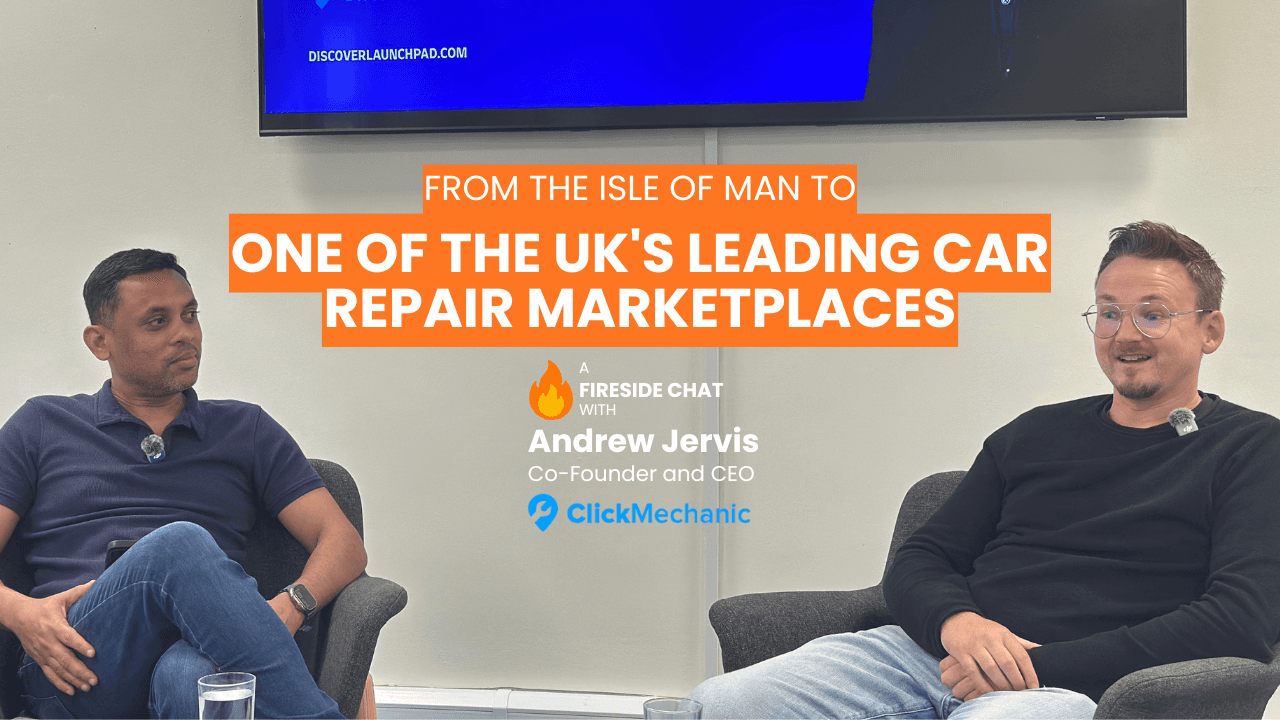
Andrew Jervis grew ClickMechanic from a £5 domain to a UK-wide marketplace. What he learned about trust, hiring, funding and scaling, from our fireside chat.
15 September 2026
Quick answer
What does it take to go from startup to scale-up?
According to Andrew Jervis, co-founder and CEO of ClickMechanic, there is no single moment. You get there by testing ideas fast, baking trust into your product, hiring slowly for culture fit, and planning in quarters while acting in weeks. ClickMechanic, founded in 2012, still grows 30 to 40% a year. (Source: Launchpad Fireside, 19:09)
Andrew grew up on the Isle of Man. His grandad fixed tanks in the war. His dad built a Kia dealership. His brother is a mechanic.
Andrew picked up a pen instead of a spanner. He wrote an 85,000-word thesis on why car repair was broken, then spent the next 14 years fixing it. (Source: Launchpad Fireside, 0:54)
We sat down with him at Launchpad to unpack what he learned. Whether you run a business, want to start one, or simply want to work smarter in a growing team, these lessons travel well.
Key takeaways
→ Launch before you feel ready. ClickMechanic's first site went live in a week. (10:52)
→ Build trust into the product, not the marketing. (8:21)
→ Hire for culture as hard as you hire for skill. (22:28)
→ Early investors back the team. Later investors back the numbers. (26:57)
→ Plan strategy by the quarter. Act tactically by the week. (1:08:37)
1. Research the problem, then test it in the wild
Most founder stories involve dropping out of university. Andrew went the other way. He left the Isle of Man for a research masters at the University of Manchester and studied the car repair market in depth. (Source: Launchpad Fireside, 0:54)
His research found a £25 billion annual market where half of customers were unhappy. That size of problem got him into Entrepreneur First, a London accelerator, where he met his co-founder Felix, a software engineer. (Source: Launchpad Fireside, 2:33)
But research only takes you so far. Andrew's view is blunt. People won't tell you your idea is bad if you ask them.
"There's no substitute for getting a minimum viable product out in the wild." (Source: Launchpad Fireside, 17:56)
Try this: Swap "Is this a good idea?" for a test where people have to act. A booking, a sign-up, a payment. Tools like session recordings and heat maps then show you what people do, not what they say.
2. Your first version can cost almost nothing
In week one, Andrew and Felix built a basic website with two bookable services. They used free hosting and a free Google AdWords voucher. The only thing they paid for was a domain name, around £5. (Source: Launchpad Fireside, 10:52)
They put it live on a Friday and went to the pub. By Saturday, one customer had booked.
The catch? They had zero mechanics.
So Andrew grabbed a Yellow Pages and rang garages in Birmingham until one agreed to take the job. The customer was happy. The mechanic asked for more work. The revenue went straight back into ads, and the flywheel started turning. (Source: Launchpad Fireside, 12:13)
The lesson: Validation first, polish later. Andrew told us he has watched too many people spend a year or two building the "perfect" product, launch it, and find nobody comes. (Source: Launchpad Fireside, 37:43)
What is the leanest test you could run on your idea this week?
3. In a low-trust industry, trust has to live inside the product
Car repair is emotional. Andrew called a car the second most expensive purchase most people make, and bad work can put lives at risk. One ClickMechanic investor, a former Just Eat CEO, told him the problem was far harder than takeaway delivery. (Source: Launchpad Fireside, 7:08)
ClickMechanic builds trust in three layers:
Vetting on entry. Mechanics need at least five years' experience, relevant qualifications, trade insurance, identity checks and a conversation with the team. In one month, almost 1,000 applied and 65 were approved at the time of recording. (Sources: 8:21, 24:12)
Fair, data-led pricing. The company licenses hundreds of millions of data points on repair times and parts prices, so quotes reflect industry standards. (Source: 8:21)
Ongoing quality checks. Because payments run through the platform, the team sees ratings and performance. Mechanics who fall short get suspended, then banned. Andrew estimates over a thousand bans over the years. (Sources: 9:41, 24:12)
The result, in Andrew's words, is a Trustpilot score around 4.7 and a Net Promoter Score around +87, against a typical +40 to +50 in automotive. (Source: Launchpad Fireside, 9:41)
4. Scale-up status creeps up on you
We asked when ClickMechanic stopped feeling like a startup. Andrew said there was no "aha" moment. It was a gradual realisation: product-market fit, profitability, and year-on-year growth of 30 to 40% on much bigger numbers. (Source: Launchpad Fireside, 19:09)
Funding stages (pre-seed, seed, Series A and beyond) give rough guardrails, but no hard rules.
5. What broke first: hiring too fast
By 2016, ClickMechanic had a team of 10 and had reached break-even. They then raised a round led by London VC Forward Partners. (Source: Launchpad Fireside, 20:56) Press at the time reported a $1 million round, announced in January 2017, with 500 Startups and former Just Eat CEO Klaus Nyengaard also investing. (Source: UKTN)
VCs want you to move fast. So the team went on a hiring spree, from 10 to 30 people, and cut corners. Some hires did not fit the culture, and the harmony they had built started to crack. (Source: Launchpad Fireside, 21:33)
The fix: Every hire now goes through culture interviews with six to eight team members, alongside the skills interview. Andrew shared a recent example. A head of operations candidate looked brilliant on paper. The culture round flagged he would not gel with the team, and they passed. (Source: Launchpad Fireside, 22:28)
Andrew says attrition is now close to zero, and nobody has resigned in years. (Source: Launchpad Fireside, 23:12)
6. How the funding story changes at each stage
Andrew's framing is simple:
Early rounds: it is almost all about the team. Investors back the founders.
Middle rounds: they want proof points, like traction. What counts depends on your sector. A consumer marketplace can show traction fast. A biotech company waits on approvals.
Later rounds: the fundamentals of the business matter more than the founders.
(Source: Launchpad Fireside, 26:57)
His most useful insight? Investor FOMO. Getting the first 20% of a round committed is hard. Once you pass 70 to 80%, fear of missing out kicks in. He reckons the first half of a raise is three times harder than the second. (Source: Launchpad Fireside, 29:57)
He also turned down extra money when the 2016 round was oversubscribed. They did not need it and did not want the dilution. (Source: Launchpad Fireside, 29:00)
Andrew summed it up: fundraising is a bit of an art, scaling a business is closer to a science. (Source: Launchpad Fireside, 30:59)
7. Plan for bad days, because they come
ClickMechanic's last major raise was not cash. It was an airtime-for-equity deal with UKTV, owner of channels like Dave. (Source: Launchpad Fireside, 25:54) UKTV Ventures invested £1 million of commercial airtime in January 2020. (Source: FleetPoint)
The TV campaign went live just before COVID. People stopped driving. Thanks to a break clause, they stopped after spending roughly £300,000 to £400,000 of it. (Source: Launchpad Fireside, 25:54)
Then site traffic dropped 50% overnight. The team launched contact-free repairs using mobile mechanics, and conversion rose 50%. That balanced out the damage. (Source: Launchpad Fireside, 32:48)
Andrew was open about the tight spots too. Shrinking runway, founders taking next to no salary for months, hard calls on the team. (Source: Launchpad Fireside, 31:25)
How many months of runway do you have right now, and what would you do if it halved?
8. Don't rush the "big hire"
A 21-year-old founder in the audience asked when to bring in an experienced C-suite hire. Andrew's answer: a senior leader from a mature company can struggle in a hands-on team of 10. Hire them too early and it can go badly wrong. (Source: Launchpad Fireside, 51:32)
He favours promoting from within. ClickMechanic's first two interns joined around the start of 2014. One is now head of growth. The other moved from customer service through account management, quality assurance and product management to head of product. (Source: Launchpad Fireside, 52:22)
When they did hire externally, their operations director came from smaller companies and worked closely with a CEO before. Right fit, right time. (Source: Launchpad Fireside, 53:11)
9. Keep culture alive with small, repeatable habits
ClickMechanic has four company values, and they show up everywhere:
Employee of the month: team members give kudos, but must name the value it reflects.
Annual "Clicky Awards": employee of the year goes to whoever best embodies all four values.
Twice-yearly reviews: staff score themselves on the values, and managers score them too.
(Source: Launchpad Fireside, 55:20)
Our favourite idea from the night was a "Working with Andy" document. It is a one-page guide to how Andrew likes to work, check things and receive feedback. His direct reports write their own. (Source: Launchpad Fireside, 57:44)
You could write yours in 20 minutes. Who on your team would benefit from reading it?
Every employee also gets share options, based on salary and level, with a four-year vesting schedule and a one-year cliff. (Source: Launchpad Fireside, 58:47)
10. Think in quarters, act in weeks
ClickMechanic runs on OKRs (objectives and key results), a format popularised by Google. They hold an annual retrospective, set company OKRs each quarter, and teams build their own OKRs underneath. (Source: Launchpad Fireside, 1:00:11)
A real example: in Q1, bookings rose and the mechanic acceptance rate fell from the mid-to-high 80s to the low 80s. Q2's company objective was to fix it. Teams ran weekly tactics, like direct mail and trade website ads in weak regions. By June, the rate hit 89%. (Source: Launchpad Fireside, 1:06:19)
New tools come from the bottom up too. Teams pitch business cases in quarterly retros. That is how ClickMechanic moved its customer system to Zendesk. (Source: Launchpad Fireside, 1:04:25)
How ClickMechanic uses AI
Operations: Revenue doubled over the last couple of years without growing the operations headcount, largely thanks to AI. (Source: 45:45)
Customer service: AI handles email resolutions, with AI call answering in progress. (Source: 45:45)
Pricing: Machine learning helps optimise parts pricing in the quoting engine. (Source: 45:45)
The risk: ClickMechanic relies heavily on Google search. As more people research through AI tools, Andrew flagged "Google zero" as something the team watches closely. (Source: 46:51)
Can you build a UK-wide business from the Isle of Man?
Andrew thinks so. The Island has about 80,000 people, yet in his view it has far more entrepreneurs and talent than a UK town of the same size. (Source: Launchpad Fireside, 35:41)
His early mentors came from a small Island incubator. He has worked from Eagle Labs and from Launchpad, and he backs local investors as a real asset. (Source: Launchpad Fireside, 37:07)
He now invests small amounts himself, including in Skin Scanner, founded by Joshua Sinclair. They met two desks apart at Launchpad. (Source: Launchpad Fireside, 42:06)
The Island also suits early testing. A small, digitally savvy population makes it simple to run a local ad and validate an idea quickly. (Source: Launchpad Fireside, 43:06)
Books Andrew recommends
The Lean Startup by Eric Ries. Andrew calls it the bible ClickMechanic lives by. (Sources: Launchpad Fireside, 37:43, Masters of Scale)
Venture Deals. His pick for anyone thinking about fundraising. (Source: Launchpad Fireside, 42:06)
FAQs
How did ClickMechanic start?
Andrew Jervis researched car repair problems during a masters at the University of Manchester, then joined the Entrepreneur First accelerator in London in 2012. There he met co-founder Felix and launched a basic booking site within a week. (Source: Launchpad Fireside, 2:33)
How does ClickMechanic make money?
Customers get a fixed, industry-standard quote online and book a mostly mobile mechanic. An algorithm offers the job to mechanics, similar to Uber. ClickMechanic takes a 20% commission, and mechanics pay nothing to join. (Source: Launchpad Fireside, 44:59)
How do you validate a startup idea cheaply?
Launch the smallest version that lets real people take action, such as booking or paying. ClickMechanic tested demand in its first week using free hosting, a free ad voucher and a cheap domain. (Source: Launchpad Fireside, 10:52)
What do investors look for at each funding stage?
Early investors mainly back the founding team. Later investors look for traction and strong business fundamentals. (Source: Launchpad Fireside, 26:57)
How do you keep quality high on a marketplace as you scale?
Vet suppliers strictly on entry, then monitor ratings and performance continuously. Suspend or remove anyone who falls below standard. (Source: Launchpad Fireside, 24:12)
When should a startup hire senior executives?
When the role fits your current stage and culture. Andrew warns that hiring a senior leader from a large company too early can backfire in a small, hands-on team. (Source: Launchpad Fireside, 51:32)
Can you build a startup from the Isle of Man?
Yes. Andrew says the Island punches above its weight for talent, mentors and investors, and its small, digital population suits early testing. (Source: Launchpad Fireside, 35:41)
Watch the full conversation
Related Articles
General14 min read
What Is a Pre-Seed Startup? 4 Founders on What Actually Works
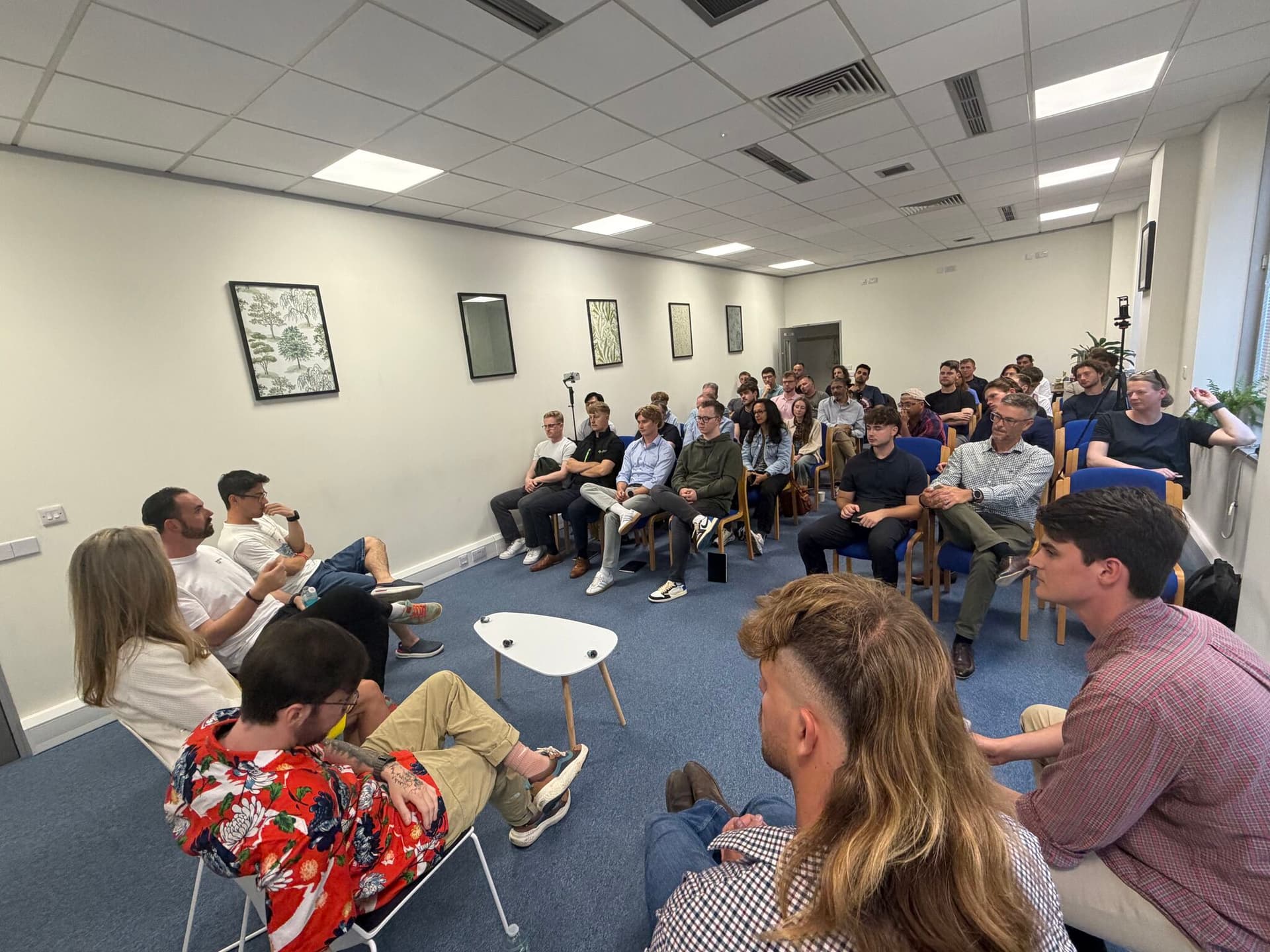
Four founders explain what pre-seed really means, how to find your first 50 users, when pricing forces honest feedback, and how to grow with no budget. Recorded live at Launchpad, Isle of Man.

General1 min read
Launchpad Summer Cricket Day 2026: A Recap
A recap of Launchpad's Summer Cricket Day at Crosby Cricket Club, sponsored by Clay, bringing the Isle of Man startup community together for an afternoon outdoors.
Ready to Join Launchpad?
Experience the co-working difference. Book a tour or sign up for a membership today.