Back to Blog
General3 min read
The "Skyscanner" of Gaming: How Skinscanner.gg is Decoding the $53B Digital Asset Market
CP
Chamara Peiris
7 May 2026
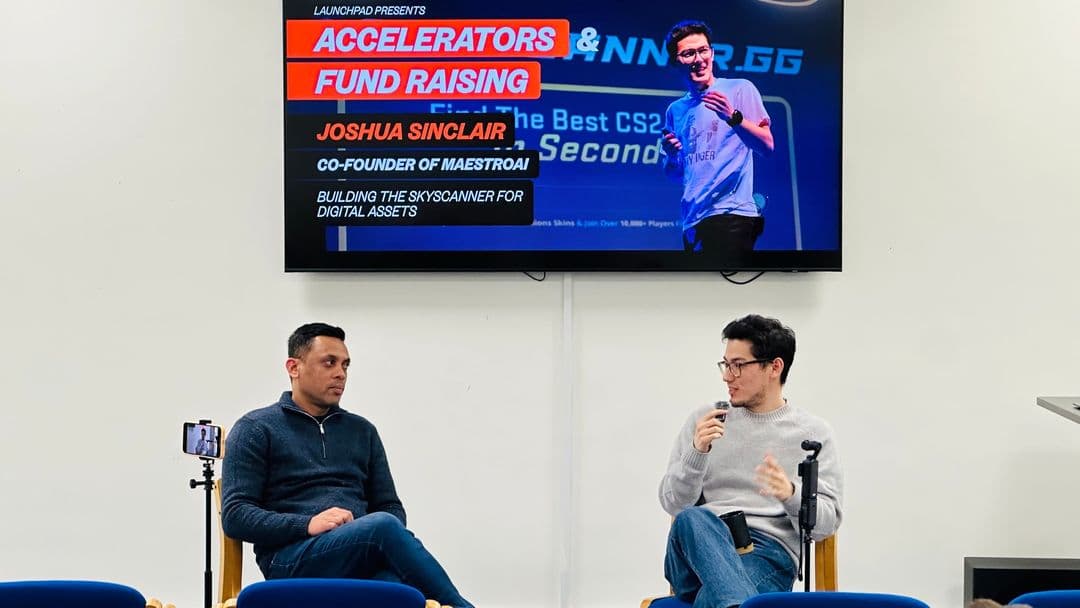
You’ve spent hundreds of hours in Counter-Strike. You’ve bought the "skins," the accessories, and the digital flair. But to the average investor, those pixels are invisible. To Joshua Sinclair, they are a high-liquidity asset class waiting for a search engine.
At a recent Launchpad fireside chat, Josh—Co-Founder of Skinscanner.gg—sat down with Chamara Peiris (Head of Startup Ecosystems) to pull back the curtain on one of the most grueling transitions in the startup world: moving from a university dorm to a venture-backed powerhouse in a Tier-1 accelerator.
If you think a startup is about a comfortable 9-to-5, Josh’s story is a wake-up call. This is about "sink or swim."
Finding the "Skyscanner" Hook
The biggest hurdle for Skinscanner.gg wasn't the technology—it was the language. How do you explain tradable in-game assets to a room full of 400 investors who might not even own a console?
Josh’s breakthrough came from Narrative Framing. By positioning the platform as the "Skyscanner of Gaming," he instantly anchored a complex, high-frequency trading environment to a utility everyone understands: aggregating data across scattered marketplaces to find the best deal.
"If you can’t explain your business to a four-year-old without bruising their ego, you haven't simplified it enough."
42 Experiments in 30 Days
When Josh joined Baltic Ventures, he thought he knew his users. The accelerator's coaches—all successfully exited founders—disagreed. What followed was what Josh calls "founder therapy": a brutal stripping away of assumptions.
The Pivot to Scale
Under the heat of the accelerator, Skinscanner.gg didn't just tweak their product; they went into a frenzy of iteration.
The Challenge: The growth engine was stalling.
The Response: The team ran 42 different experiments in a single month.
The Result: They found their "Eureka" moment. By the end of the program, they were onboarding 1,000 new members every week.
Fundraising is a Full-Time Job (And Then Some)
Josh’s journey to a £300k round involved 15-hour flights to Singapore, writing a dissertation on a plane, and maintaining a 17% university attendance rate while coding until 3:00 AM.
The "Memorable" Investor Strategy
In a market saturated with pitch decks, Josh raised his first £100k without a formal deck. How?
Strategic Angels: He targeted exited founders who understood the gaming niche.
The FOMO Effect: He leveraged the interest of "big fish"—including an investor who sold their company to Sony—to create a domino effect among VCs.
The Human Connection: At Demo Day, he focused on being memorable. "Investors don't want to talk about checks when they have a drink in their hand," Josh noted. "They want to know who you are."
The Contrarian Take: Leave the Small Pond
Josh’s advice for Isle of Man founders is a "tough love" reality check: Leave. Not forever, but long enough to realize that being a "big fish in a small pond" is a trap. To build a company that is truly "VC backable"—one capable of returning an entire 40% of a £100M fund—you have to compete in an environment where everyone is at the top of their game.
"You can always come back for the tax benefits," Josh joked, "but you have to go out and find the problems first."
Actionable Takeaways for Founders
Kill the Ego: If a mentor tells you your data is wrong, don't defend it. Test it.
Network = Net Worth: Use accelerators for the network, not just the cash. A "warm intro" is worth 1,000 cold emails.
Commit 110%: You can't build a unicorn part-time. At some point, you have to "sink or swim."
Watch the Full Fireside Chat
Relive the full conversation between Chamara Peiris and Joshua Sinclair below:
Related Articles
General5 min read
Cloud Computing for Small Business: What Every Isle of Man Founder Should Know
Public, private or shared cloud? What Isle of Man founders need to know about cloud risk, AI data and data sovereignty, from Domicilium's Steven Ferrario.
General11 min read
Startup to Scale-Up: 10 Lessons from ClickMechanic's Andrew Jervis
Andrew Jervis grew ClickMechanic from a £5 domain to a UK-wide marketplace. What he learned about trust, hiring, funding and scaling, from our fireside chat.
Ready to Join Launchpad?
Experience the co-working difference. Book a tour or sign up for a membership today.