Back to Blog
General5 min read
Cloud Computing for Small Business: What Every Isle of Man Founder Should Know
Public, private or shared cloud? What Isle of Man founders need to know about cloud risk, AI data and data sovereignty, from Domicilium's Steven Ferrario.
29 September 2026
You use the cloud every day. Your email. Your accounting software. The photos on your phone.
So where does that data sit? And who can get to it?
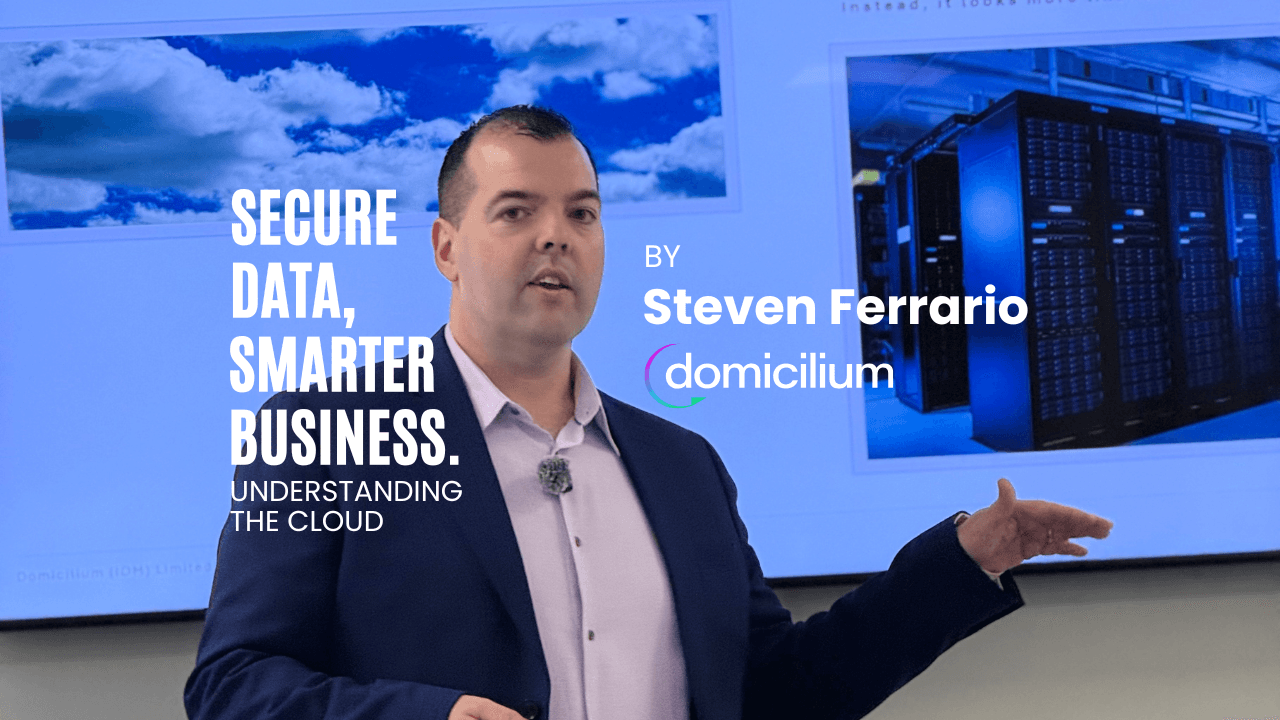
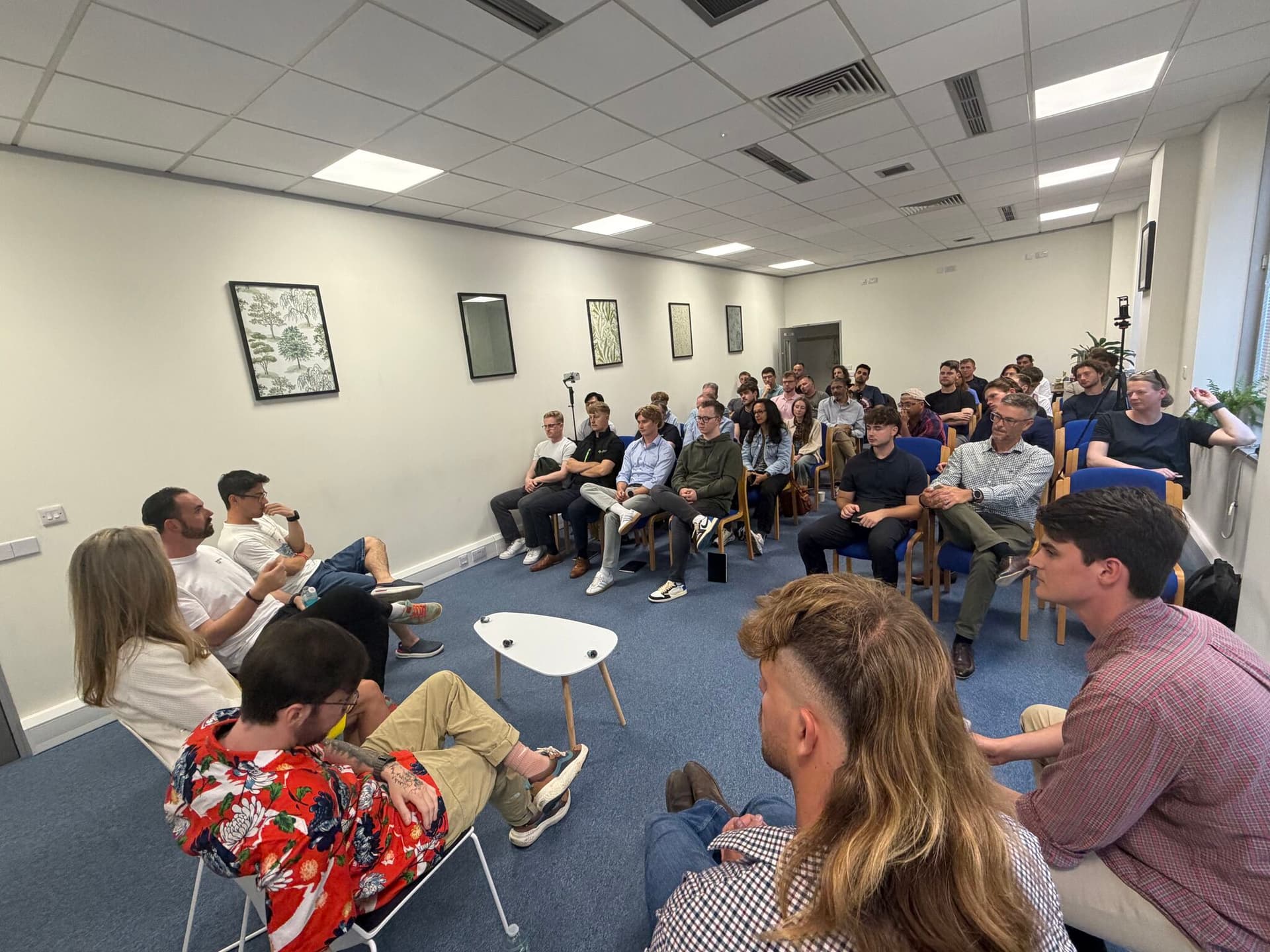
Steven Ferrario has spent almost 20 years in telecoms and IT. He's an account manager at Domicilium, the Isle of Man internet and cloud provider founded in 1991. At Launchpad, he broke the cloud down in plain English for local founders.
This guide pulls out what matters for your business.
Key takeaways
Cloud computing means your data and apps run on servers in someone else's data centre, reached over the internet.
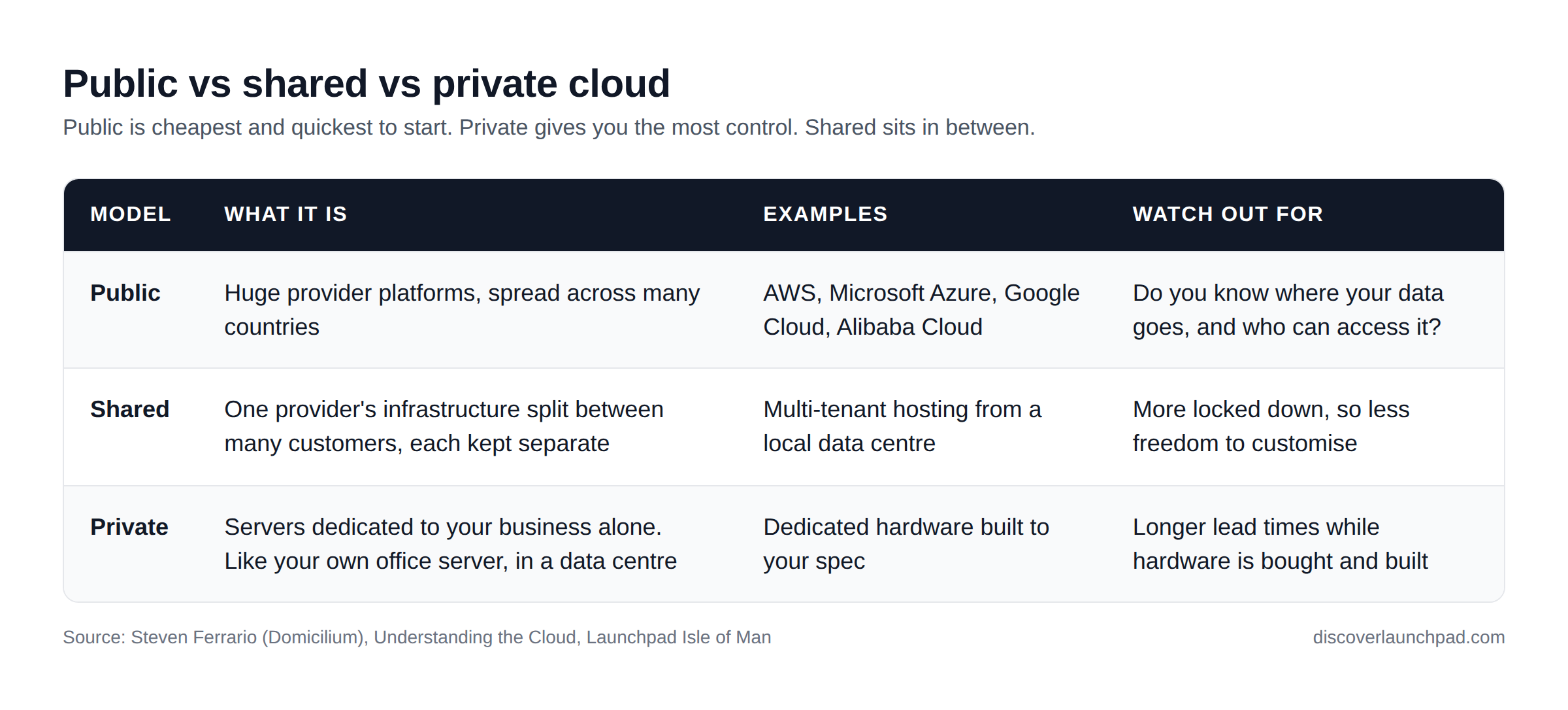
There are three main models: public, shared and private. Each trades cost and speed against control.
Choose based on regulation, data residency, security, compliance and scale.
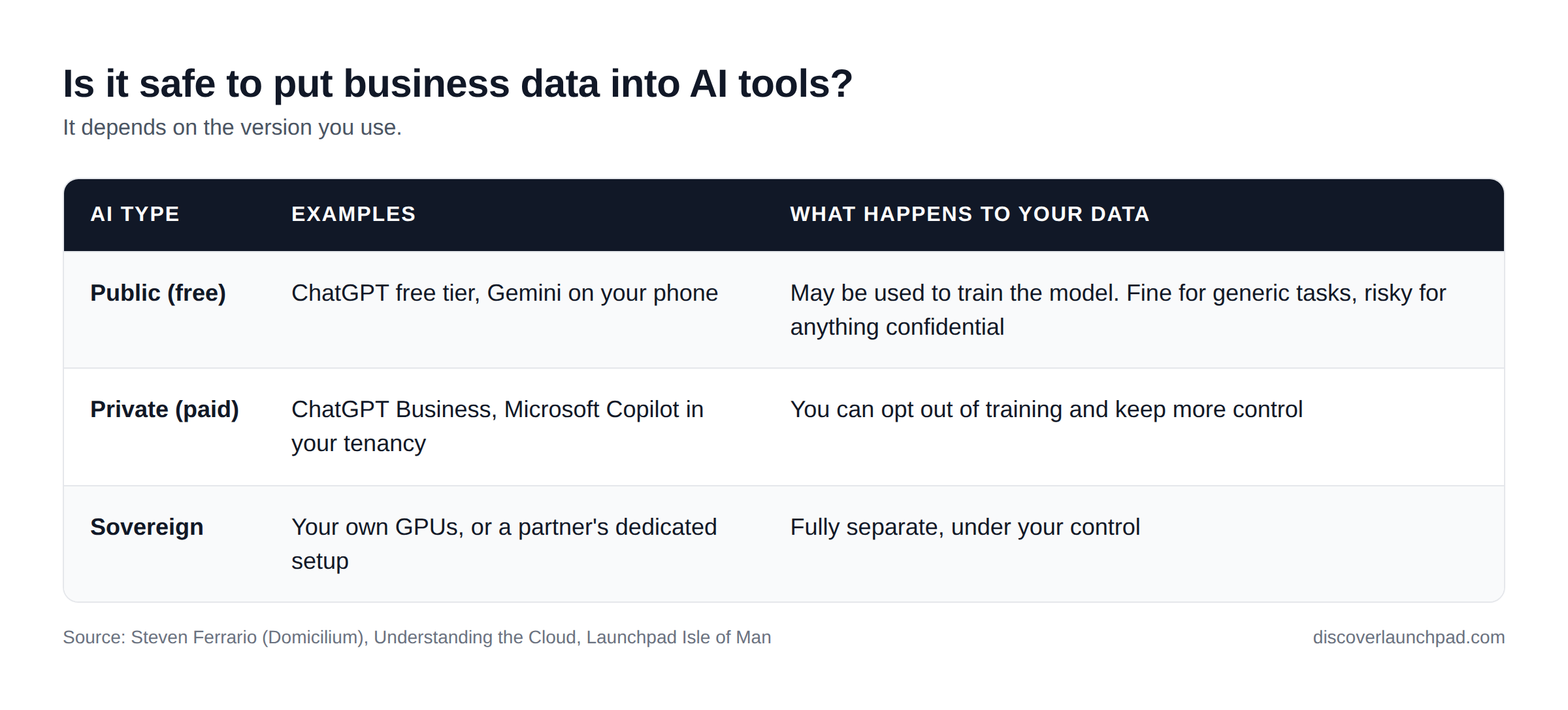
Free AI tools may train on what you type. Paid business tiers give you more control.
The US CLOUD Act lets US authorities compel US providers to hand over data, even when it's stored abroad.
Don't take providers at face value. Ask them to prove backups, certifications and security.
What is cloud computing?
Cloud computing is storing data and running software on servers you don't own, in a data centre you reach over the internet.
Steven's kids think he sells fluffy white clouds. The reality is rows of server racks in data centres around the world. Every time you open Netflix, Facebook or your banking app, your data travels to one of them.
For your business, that brings real upsides:
Scale. You add capacity without buying new kit. The old office server under the desk couldn't do that.
Uptime. Your team can reach systems from anywhere, as long as the internet is up.
Cost. You pay for what you use, not for hardware that sits idle.
The catch? A breach or ransomware attack can damage your credibility overnight.
How do you choose the right cloud for your business?
Start with your obligations, not the price tag. Steven's first questions:
Are you regulated?
Does your data have to be hosted locally?
Can it live in Microsoft 365, or not?
Then weigh up data residency, security, compliance and scale.
The biggest risk is a data breach. So check each provider's security controls, certifications, service agreements and track record.
Look at the third-party software you rely on too. Is it ISO or NIST accredited? Would you know if it wasn't? Cyber Essentials, the UK Government-backed minimum standard run by the NCSC, is a sensible baseline.
No single option wins every time. In March 2026, drone strikes damaged three AWS facilities in the UAE and Bahrain, and AWS told customers to fail over to other regions. Hyperscalers can do that at speed. Could a single local site?
And think about the exit before you sign. Moving terabytes out of a hyperscaler can bring heavy egress charges.
Paid tools still need guard rails. Roll out Copilot without testing, and staff might find your payroll data.
When Steven asked the room who had an AI usage policy, the best answer was "it's in draft". Does yours exist yet?
His own habit: anonymise everything before it goes into an AI tool. Help is coming locally too. The Isle of Man Government launched a £1 million National AI Office in January 2026, with responsible-use guidance on its first-year list.
What is data sovereignty, and why does the US CLOUD Act matter?
Data sovereignty means your data is governed by the laws of the place it's held, and the company that holds it.
The US CLOUD Act, passed in March 2018, requires US providers to hand over data when US law enforcement asks, even if it sits outside the US. If your provider is American-owned, that power overrides the contract you signed with them.
A real example: in May 2026, Microsoft was accused of sharing emails with the US House of Representatives that named civil servants at two Dutch regulators, unredacted. Steven used this case to show why contract assurances only go so far.
Europe is responding. Nextcloud, IONOS and Proton are backing Euro-Office, an open-source alternative to Microsoft Office. Some businesses are moving data back to their own jurisdiction, or even back on-premises.
On the Isle of Man, several providers offer local hosting and small business solutions.
What can you do this week?
Ask questions. Ask peers how they use AI. No question is a stupid one.
Challenge the AI. Push back when an answer looks wrong. Don't trust the first response.
Challenge your provider. Ask for proof that backups run and restores work.
Do your due diligence. Review contracts, certifications and security controls before adopting any AI tool.
Map your suppliers. Does your accounting software send data somewhere you don't know about?
Write an AI usage policy. Even a one-page draft beats nothing.
Frequently asked questions
What is cloud computing in simple terms? Cloud computing means storing data and running software on servers in a data centre you reach over the internet, instead of on your own machines.
What's the difference between public and private cloud? Public cloud runs on large shared platforms like AWS, Azure and Google Cloud. Private cloud is infrastructure dedicated to your business alone, giving you more control but longer set-up times.
Which cloud is best for a small business? It depends on whether you're regulated, where your data must live, and how much you need to scale. Start with those questions, then compare cost.
Is it safe to use ChatGPT for business? Free versions may train on what you type, so keep confidential data out. Paid business tiers let you opt out of training, but you still need a usage policy.
What is the US CLOUD Act? A 2018 US law that requires US providers to hand over data to US law enforcement, even when that data is stored outside the US.
Can I host my business data on the Isle of Man? Yes. Several Island providers offer local hosting and small business solutions.
Watch the full talk
Steven's session runs 46 minutes, including a lively Q&A on Microsoft 365, egress costs and local hosting (talk).
Want more sessions like this? See what's on next at Launchpad events.
Related Articles
General11 min read
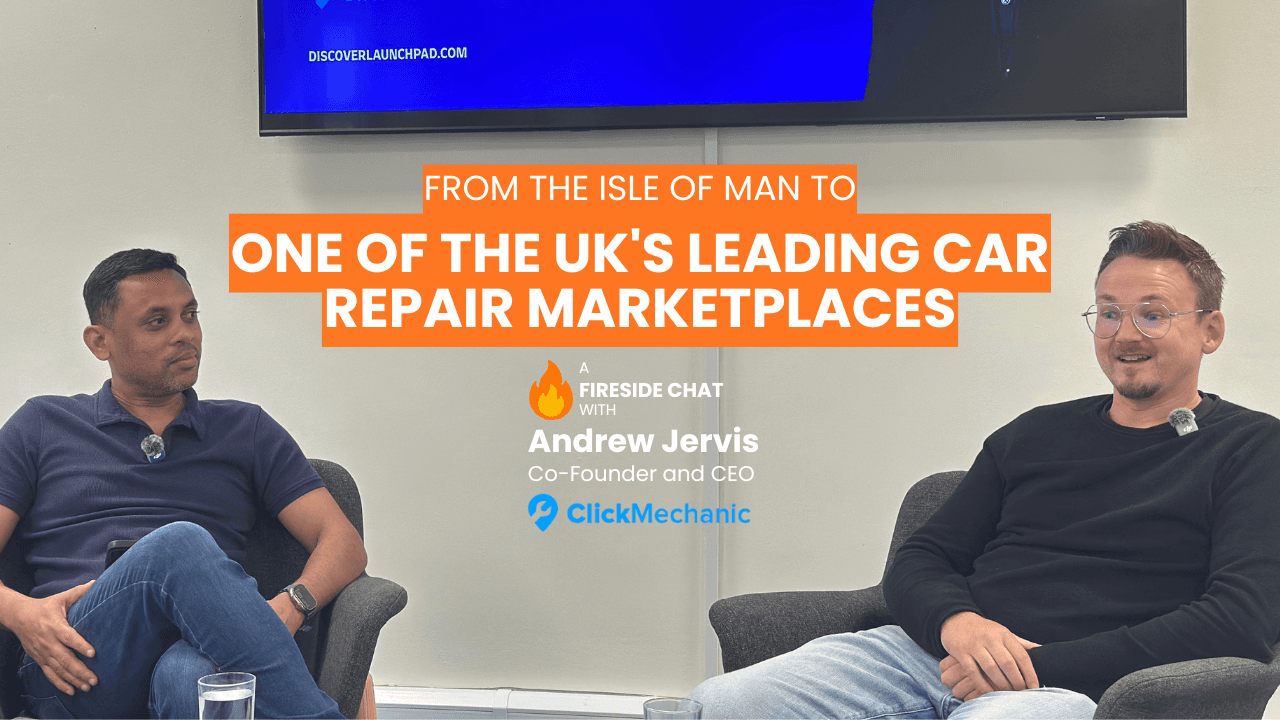
Startup to Scale-Up: 10 Lessons from ClickMechanic's Andrew Jervis
Andrew Jervis grew ClickMechanic from a £5 domain to a UK-wide marketplace. What he learned about trust, hiring, funding and scaling, from our fireside chat.
General14 min read
What Is a Pre-Seed Startup? 4 Founders on What Actually Works
Four founders explain what pre-seed really means, how to find your first 50 users, when pricing forces honest feedback, and how to grow with no budget. Recorded live at Launchpad, Isle of Man.
Ready to Join Launchpad?
Experience the co-working difference. Book a tour or sign up for a membership today.