Back to Blog
General7 min read
What a $7M Series A Really Takes: Lessons from Manx Founder Liam Downward
CYRISMA co-founder Liam Downward shares 9 lessons from Douglas to New York on networking, productising, fundraising, first hires and founder health.
23 November 2026
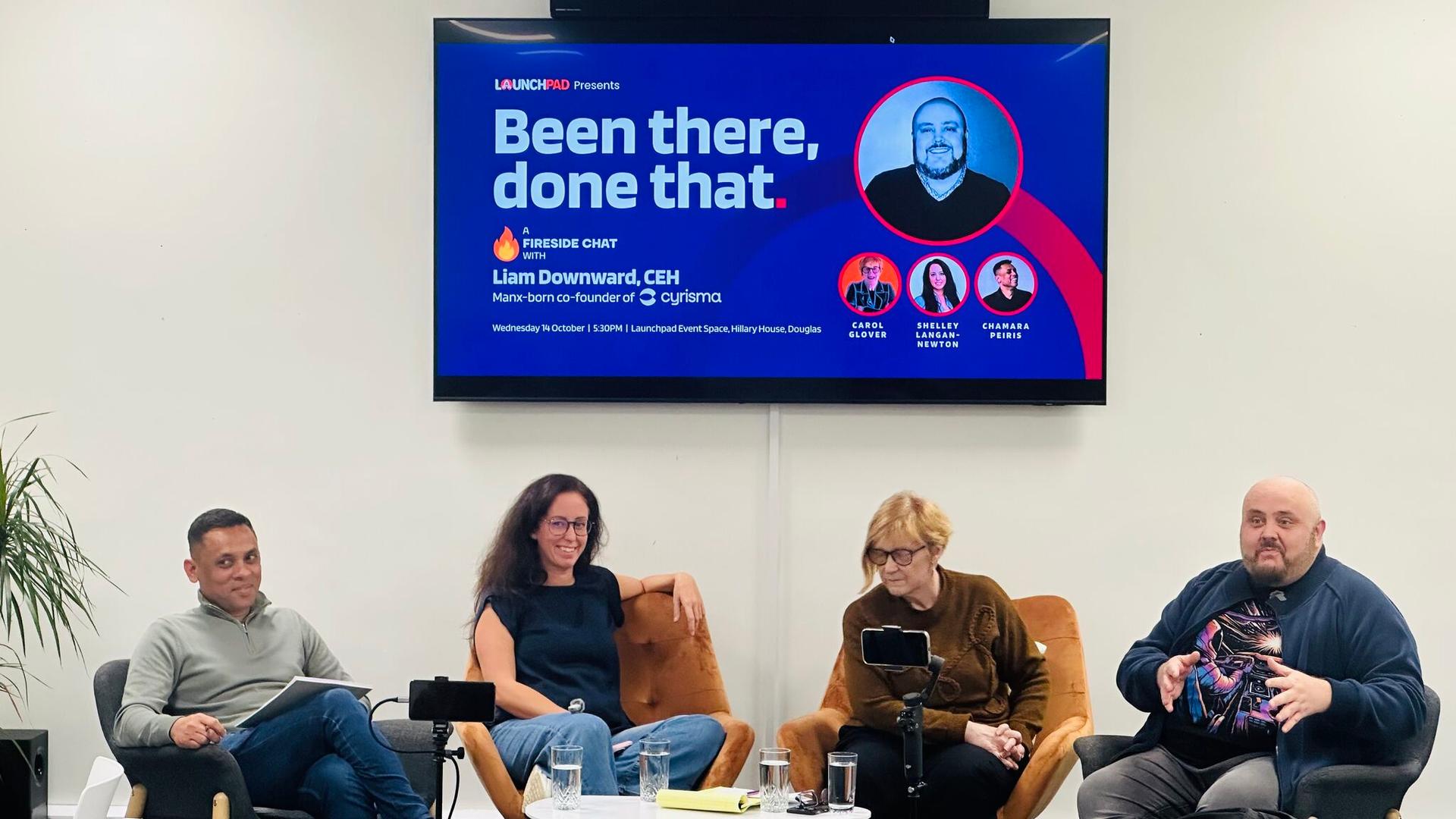
Recorded live at Launchpad, Hillary House, Douglas, on 14 October 2026. Questions from Carol Glover, Shelley Langan-Newton and Chamara Peiris. Watch the full conversation on YouTube.
TL;DR: Liam Downward left the Isle of Man in 1999, built a cyber security career in Hawaii and New York, and co-founded CYRISMA in Rochester in 2018. The company raised a $7M Series A in 2024. His advice for founders: build your network by turning up and listening, test your product idea in stealth with people who will be honest, line up three or four term sheets instead of one, hire a salesperson first, and protect your health before it forces the issue.
Key facts
Who: Liam Downward, born and raised in Douglas, Isle of Man. Left the island in 1999.
Company: CYRISMA, a cyber risk management platform for managed service providers (MSPs). Legal entity Data Spotlight Inc, registered 8 August 2018.
Funding: $50,000 from an incubator, roughly $2M on a SAFE note, then a $7M Series A led by Blueprint Equity in October 2024.
Role today: co-founder and Chief Product Officer, after almost four years as CEO.
Earlier exit: a self-funded business started in 2005 and sold in 2015.
1. How do you build a network when you know nobody?
You go to the events and you join the conversation. Liam arrived in the US with no network and spent six months without a job.
His method is simple:
Go to networking events, even when it feels awkward.
Listen first. Wait until you have something to add.
Contribute, then introduce yourself. The ice is broken and the next question is "What do you do?"
Use friends of friends. His first US job came through someone who knew someone with an opening, not through an interview round.
When you go to an event next month, which conversation will you walk into instead of standing by the wall?
2. Is selling about pitching or about being yourself?
Liam uses an 80/20 split. 80% is you, your personality and what you stand for. 20% is sales skill, mostly listening for the details that matter to the other person.
He also asks founders to decide early: do you want a lifestyle business that pays the bills, or a company built for an exit? The answer changes how hard you push.
3. How do you turn consultancy into a product?
Spot the repeat problem, then test it with people in the industry. After selling his first company, Liam kept seeing the same issue in cyber security teams: too many tools and too many people thrown at the problem.
His productising steps:
Run a weekend "war room" with yourself. Use a mind map or a whiteboard.
Build a small focus group of friends and family who work in the industry.
Ask "what if this, what if that" and take the feedback seriously.
Only then decide the architecture, the offer and the IP.
Carol Glover made the local point: the Isle of Man has plenty of smart people selling their time who haven't yet realised they could productise it.
4. Why build in stealth first?
Stealth lets you get honest feedback without spending on marketing. CYRISMA spent two years developing the product and designed it on about 110 double-sided sheets of printer paper before writing much code.
They showed those paper screens to potential customers. Three or four signed up and paid upfront, knowing the product was six months away.
Stealth also shrank the pitch. The first value proposition was "a mile long". Testing it in real sales calls cut it to a 30-second elevator pitch.
Could you get a paying customer before your product exists?
5. How should co-founders split equity?
Liam started CYRISMA, brought in two developer friends and gave each co-founder an equal third. His reason: equal stakes make people feel they own the outcome, and they make room for healthy conflict.
Roles followed strengths. Liam took CEO and product, the others took CTO and VP of software development.
After almost four years, he stepped down as CEO to focus on product and brought in someone else to handle the board. "Did I like it? No," he said. He still calls it the right decision for the company.
6. What does raising a Series A actually involve?
More time and more rejection than most founders expect. Here is what Liam shared:
The first cheque proves the idea. CYRISMA's $50,000 came from an incubator that picked seven companies a year from hundreds of applicants, in return for 5% of the company.
Expect a long list. For the seed round they approached about 175 investment firms. Around 60% didn't understand cyber security, so pitches turned into education sessions.
Budget six months minimum. A round means five to ten calls a day for months, and even a term sheet isn't final until due diligence is done.
Never rely on one term sheet. One investor pulled out at the 11th hour, which set their go-to-market back six months. Now he aims for three or four in hand.
Bring your existing investors back. When most earlier backers reinvest, new investors take you more seriously.
Research investors properly. CYRISMA used Crunchbase to see who backed similar companies. Expect around 10 to 15 replies per thousand cold emails.
Raising money costs control. Investors bring a board, votes and moving goalposts.
7. Who keeps the business running while you fundraise?
Your team, so they need to be strong. During one round, CYRISMA's sales slipped by around 10% between board meetings. Liam realised some people he thought were A players had been carried by the founders now busy fundraising.
Their first hire was a sales development rep making cold calls. A founder who cold calls, demos and implements makes the company look small. The second hire was a finance person.
8. Which go-to-market tactics worked?
Fewer events and more personal ones:
One year CYRISMA spent almost $1M on events. Cutting to three events a year brought a better return.
Industry lists, such as the top 500 MSPs in North America, gave them targets for calls and meetings.
Whisky tastings in a rented Airbnb turn 60% to 70% of guests into contracts, because people remember them.
City dinners mixing customers and prospects create conversations a trade show booth can't.
Sizing the market mattered too. Liam counted about 44,000 service providers in North America looking after 2.2 million companies.
9. How do you protect your health as a founder?
Treat it as part of the job. Liam was candid: stress, skipped meals and long hours took a physical toll, and a recent health issue forced him to change how he works.
What kept him going was his faith and a family who backed the idea. He works from home where he can, so he stays close to his wife and son.
His view on failure: you learn from it, and it only stays a failure if you don't change.
What does this mean for the Isle of Man?
Liam came back for his family's safety, not for business. CYRISMA's headquarters stays in the US and its European hires sit in North Macedonia, Poland and Hungary.
His challenge to young islanders: think internationally from day one. His new venture, One Island, starts on the Isle of Man with plans for Jersey, Guernsey and Malta.
He also wants entrepreneurship taught earlier. In the US, he said, children start learning business basics around 12 or 13, from budgeting to fundraising.
If you're building here, what's the one thing you'd need to stay?
Frequently asked questions
Who is Liam Downward? Liam Downward is a cyber security entrepreneur born in Douglas, Isle of Man. He co-founded CYRISMA in Rochester, New York, in 2018 and serves as its Chief Product Officer.
What does CYRISMA do? CYRISMA is a cyber risk management platform that helps managed service providers find and fix security risks for the small businesses they support.
How much has CYRISMA raised? CYRISMA raised a $7M Series A in October 2024, led by Blueprint Equity with SaaS Ventures and Golden Ventures. SecurityWeek reported total funding close to $9M.
How long does it take to raise a Series A? Liam advises planning for at least six months, including due diligence after the term sheet.
What should a startup's first hire be? For CYRISMA it was a sales development rep, so the founder could stop cold calling and focus on demos.
How do you turn consultancy into a product? Run a focused "war room" session, test the idea with a small group of people in your industry, and sell the concept before you build.
Join the next conversation
Launchpad runs free fireside chats and events for founders and builders at Hillary House, Prospect Hill, Douglas. Can you join us at the next one? See what's on at discoverlaunchpad.com.
Related Articles

General5 min read
Techstars Startup Weekend Douglas is a finalist for Education and Learning Initiative of the Year at the Media Isle of Man Awards for Excellence 2026
Techstars Startup Weekend Douglas, hosted at Launchpad, is a finalist for Education and Learning Initiative of the Year at the Media Isle of Man Awards for Excellence 2026. See what participants learnt in 54 hours.
General5 min read
Cloud Computing for Small Business: What Every Isle of Man Founder Should Know
Public, private or shared cloud? What Isle of Man founders need to know about cloud risk, AI data and data sovereignty, from Domicilium's Steven Ferrario.
Ready to Join Launchpad?
Experience the co-working difference. Book a tour or sign up for a membership today.